AI-Powered Custom ERP
Development That Thinks.

Off-the-shelf ERPs are digital filing cabinets — they record data but never learn from it. Pixel Tech™ builds.

AI-Native Architecture Multi-Tenant Architecture
AI-Powered Custom ERP Development Services by Pixel Tech™

0+

Years Enterprise Experience

0%

Referral-Based Growth

0+

Ecosystem Products

0%

Avg. Cost Reduction

0+

Industries Served

0

Pay on Milestones Met
ERP Modules

Eight AI-Powered ERP Modules
Built to Run Your Business

Every module in the Pixel ERP™ platform is powered by AI at its core — not bolted on as an afterthought. Built on enterprise.

Sales & CRM

AI-powered lead scoring, pipeline automation, and intelligent deal routing. The CRM module uses machine learning to predict close.

  • AI lead scoring & prioritization
  • Chat-to-Proposal generation
  • WhatsApp Business integration
Finance & Accounting

Automated journal entries, AI-powered reconciliation that catches discrepancies in seconds, and real-time financial dashboards.

  • Automated reconciliation
  • Tally ERP XML sync
  • Predictive cash flow analysis
Inventory & Warehouse

AI-driven demand forecasting that predicts reorder points before stockouts occur. RFID-integrated warehouse management.

  • AI demand forecasting
  • RFID warehouse tracking
  • Auto reorder optimization
Production & Manufacturing

Bill of Materials management with AI-optimized production scheduling that minimizes waste and maximizes throughput. Predictive.

  • AI production scheduling
  • Predictive maintenance alerts
  • Real-time yield tracking
HR & Payroll

Complete human capital management with AI-powered recruitment screening, automated attendance tracking, and intelligent payroll.

  • AI recruitment screening
  • Automated payroll & compliance
  • Employee self-service portal
Procurement

AI-powered vendor evaluation with automated RFQ generation, purchase order matching, and intelligent spend analysis. The system.

  • AI vendor scoring
  • Automated 3-way matching
  • Smart spend analytics
Quality Control

AI-powered quality inspection with computer vision for defect detection, automated grading systems, and statistical process.

  • Computer vision inspection
  • Automated grading & SPC
  • Non-conformance workflows
Field Service

AI-optimized field service scheduling with route optimization, real-time technician tracking, and automated service report.

  • AI route optimization
  • Predictive service scheduling
  • Mobile-first field app
AI Intelligence Layer

The AI Brain Behind
Every ERP Decision

What separates Pixel ERP™ from every other ERP on the market is its embedded AI intelligence layer. This is not a chatbot bolted.

Demand Forecasting

Our ML models analyze historical sales data, seasonal patterns, market trends, and external signals to predict demand with up.

  • Up to 92% forecast accuracy
  • Seasonal pattern recognition
  • Auto purchase recommendations
Anomaly Detection

Every transaction flowing through Pixel ERP™ passes through an anomaly detection engine that flags unusual patterns —.

  • Real-time transaction monitoring
  • Fraud and duplicate detection
  • Adaptive threshold learning
Smart Workflow Routing

Pixel ERP™’s workflow engine doesn’t just follow static approval hierarchies — it learns your delegation.

  • Dynamic approval routing
  • Bottleneck identification
  • 60-80% faster approvals
Predictive Maintenance

For manufacturing and field service clients, our predictive maintenance AI monitors equipment telemetry data — vibration.

  • Equipment health scoring
  • Failure prediction algorithms
  • 45% less unplanned downtime
Automated Reconciliation

Pixel ERP™’s AI reconciliation engine matches bank statements, vendor invoices, purchase orders, and goods received notes.

  • Auto bank reconciliation
  • Multi-entity matching
  • 80% faster month-end close
Chat-to-Proposal

Pixel ERP™’s most innovative AI feature: speak or type a natural language description of a client requirement.

  • Voice or text input
  • ML-powered smart pricing
  • 3x faster deal closure
Architecture

Enterprise-Grade Architecture
Built for Infinite Scale

Pixel ERP™ is not a monolithic application — it is a cloud-native platform built on a cloud-native AWS architecture.

Multi-Tenant Architecture

Every Pixel ERP™ deployment runs on a fully managed, cloud-native data layer built for enterprise scale.

  • Single-digit millisecond latency at any scale
  • Partition-key based tenant isolation
  • Zero database administration overhead

Dynamic Adaptive Forms

Traditional ERPs require custom development for every new field, validation rule, or workflow change. Pixel ERP™ uses.

  • JSON-configured forms and workflows
  • Conditional field visibility and validation
  • Admin panel for business user modifications

Cloud-Native AWS Infrastructure

Pixel ERP™ runs on a fully cloud-native AWS stack: enterprise backend framework on Lambda for compute, scalable cloud database.

  • enterprise backend framework on Lambda for cloud-native compute
  • Pay-per-use pricing with zero idle cost
  • Auto-scaling to handle any traffic spike

Hub-and-Spoke Data Model

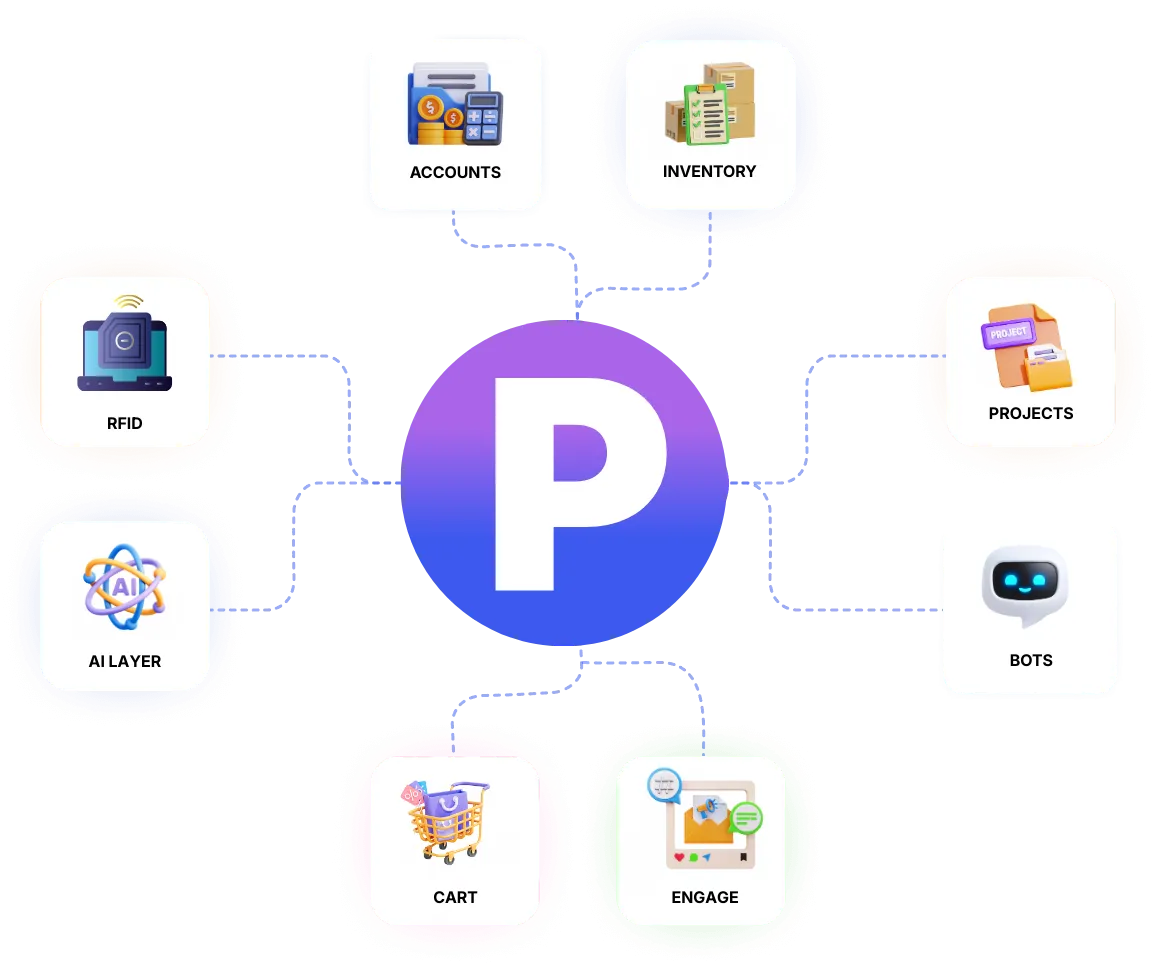
The Pixel Ecosystem uses a hub-and-spoke data model where the ERP acts as the central hub and all other modules — CRM,.

  • Single source of truth for all data
  • Real-time cross-module consistency
  • Real-time synchronization via a managed event bus
Comparison

Traditional ERP vs Off-the-Shelf
vs Pixel Custom ERP

Understand exactly why growing businesses are choosing AI-powered custom ERP development over traditional approaches. This is not.

Capability Traditional Custom ERP Off-the-Shelf (SAP/Oracle) Pixel Custom ERP
AI Integration None — manual processes digitized Bolt-on AI modules at extra cost Native AI in every module from day one
Architecture Monolithic, SQL-based, single server Legacy monolith with cloud wrapper Cloud-Native, scalable cloud database, auto-scaling
Customization Requires developer for every change Limited; expensive consultants needed Configurable; business users adapt forms
Implementation Time 12-24 months 18-36 months 8-16 weeks (milestone-based)
Total Cost of Ownership High upfront + ongoing maintenance Very high licensing + consulting fees Milestone-based; 50% lower 3-year TCO
Scaling Manual server upgrades required Vertical scaling, expensive Infinite horizontal auto-scaling
Multi-Tenant Support Separate instances per client Shared infrastructure, limited isolation Scalable Cloud Database partition-key isolation
Integration Approach Point-to-point, brittle Proprietary connectors, vendor lock-in Hub-and-spoke, real-time, open APIs
Billing Model Time & materials (hours billed) Per-user licensing + annual fees Pay on Milestones Met — zero risk
Who Builds It Junior developers, outsourced teams Large consulting firms, high turnover Founders personally architect & lead
Integrations

Seamless Integration With
Your Existing Systems

Pixel ERP™ does not force you to abandon your existing tools. Our hub-and-spoke architecture and real-time integration layer.

Tally ERP XML Integration

Bidirectional XML sync with Tally ERP 9 and TallyPrime for seamless accounting integration. Sales invoices, purchase orders,.

WhatsApp Business API

Native WhatsApp Business API integration enables order confirmations, delivery tracking, invoice sharing, payment reminders.

Payment Gateways

Integrated with Razorpay, Stripe, PayU, and CCAvenue for seamless payment collection. Customers pay invoices directly.

Shipping & Logistics

Integrated with Shiprocket, Delhivery, DTDC, Blue Dart, and custom logistics APIs for automated order fulfillment. Shipping.

Accounting Software

Beyond Tally, Pixel ERP™ integrates with QuickBooks, Zoho Books, Xero, and custom accounting platforms through API and file-based.

RFID & IoT Devices

Deep integration with Pixel IoT readers and tags for automated inventory tracking, asset management, and warehouse operations..

Industries

Custom ERP Solutions for
10+ Industries

Pixel ERP™ is not a one-size-fits-all system. Every industry gets a custom-configured ERP with domain-specific modules, workflows,.

Manufacturing

BOM, production scheduling, shop floor tracking, predictive maintenance, quality control, and yield optimization — all AI-powered.

Textiles

Loom scheduling, fabric quality grading with computer vision, yarn inventory, shade matching, export documentation, and buyer portal.

Distribution

Multi-warehouse management, route optimization, demand-driven replenishment, distributor portal, and real-time delivery tracking.

Retail

POS integration, customer loyalty programs, AI-powered inventory replenishment, omnichannel order management, and promotional analytics.

Exhibitions

RFID attendee tracking, exhibitor portal, booth allocation, catering management, lead capture analytics, and real-time event dashboards.

Professional Services

Project-based billing, timesheet automation, resource allocation, client portals, and AI-powered utilization optimization.

Process

Our 6-Step ERP
Implementation Process

Every Pixel ERP™ engagement follows a milestone-based delivery methodology. You pay only when each milestone is met and validated..

1. Discovery & Audit

Our founders conduct a comprehensive audit of your existing systems, workflows, pain points, and data landscape. We map.

2. Architecture & Design

Aman Jain personally architects the scalable cloud database schema, dynamic form definitions, workflow rules, AI model.

3. Build & Configure

Core modules are built on the Pixel ERP™ platform using our configurable engine. Custom forms, workflows, approval chains,.

4. Integration & Migration

We connect Pixel ERP™ with your existing systems — Tally, WhatsApp, payment gateways, shipping, RFID hardware, and any.

5. Training & UAT

Comprehensive user acceptance testing with your team validates every workflow, report, and integration. We conduct role-based.

6. Launch & Optimize

Production go-live with our founders on standby. We monitor system performance, user adoption, and AI model accuracy.

Results

Measurable ROI From
AI-Powered ERP

These are not theoretical projections — these are real results from Pixel ERP™ deployments across manufacturing, natural.

0%

Faster Order Processing

0%

Reduction in Manual Data Entry

0%

Less Unplanned Downtime

0%

Lower 3-Year TCO

0x

Faster Month-End Close

0%

Demand Forecast Accuracy
Founder-Led ERP Engineering

Your ERP Is Architected by
Enterprise Veterans, Not Junior Devs

Every Pixel ERP™ engagement is personally led by our founders — not delegated to junior developers, outsourced.

Aman Jain — CEO & Chief Architect

25+ years building enterprise systems at Bank of America, Merrill Lynch, and Fidelity. Personally designs every Pixel ERP™.

Garima Jain — CTO

16+ years at Accenture delivering large-scale technology transformations for Fortune 500 clients across industries. Leads quality.

Pixel Tech™ Founders — Aman Jain & Garima Jain — Custom ERP Architects
FAQ

Frequently Asked Questions About
Custom ERP Development

Pixel ERP™ is AI-native, meaning machine learning is embedded in every module — not bolted on as an add-on. It is built on a cloud-native scalable cloud database architecture that scales infinitely without the infrastructure overhead of traditional ERPs. Our dynamic form engine means you can modify screens, workflows, and reports without developer involvement. Most importantly, it is built specifically for your business and industry, not a generic system that requires expensive customization. And you pay on milestones met, not per-user licensing.

Typical Pixel ERP™ implementations take 8-16 weeks, delivered in milestone phases. Simple deployments with 3-4 modules can go live in 8-10 weeks. Complex multi-module deployments with integrations, data migration, and AI model training take 12-16 weeks. This is 3-5x faster than traditional ERP implementations because we configure our platform rather than building from scratch. Each milestone is independently tested and validated before payment.

Before the project starts, we define 5-8 milestones with specific deliverables and acceptance criteria. For example: Milestone 1 might be Discovery and Architecture, Milestone 2 might be Sales and CRM Module, Milestone 3 might be Finance and Accounting Module, and so on. When a milestone is complete, we demonstrate it. You test it against the acceptance criteria. If it passes, payment is triggered. If it does not, we fix it first. This eliminates the risk of paying for an ERP that does not work.

Pixel ERP™ is built on enterprise backend framework for the application layer, Amazon scalable cloud database for the database (cloud database, cloud-native, infinitely scalable), cloud-native compute for cloud-native compute, S3 for document storage, global CDN for global content delivery, SES for email notifications, and a managed event bus for real-time integrations. The AI layer uses purpose-built ML models. The frontend is responsive and works across desktop, tablet, and mobile. cross-platform mobile framework is used for native mobile applications.

Yes. Pixel ERP™ has native bidirectional integration with Tally ERP 9 and TallyPrime via XML. Sales invoices, purchase orders, journal entries, ledger balances, and GST data sync automatically between Pixel ERP™ and Tally. You can choose to use Tally as your primary accounting system while Pixel ERP™ handles everything else, or gradually transition accounting functions into Pixel ERP™. The integration is real-time, not batch-based, so your Tally data is always current.

Our ML models analyze your historical sales data, seasonal patterns, market trends, customer ordering patterns, and external signals (weather, economic indicators, industry trends) to predict future demand with up to 92% accuracy. The system auto-generates purchase recommendations, adjusts safety stock levels, and alerts procurement teams weeks before potential stockouts. The model improves over time as it learns from actual vs predicted results. For manufacturing clients, demand forecasts feed directly into production scheduling.

Traditional ERPs require custom development every time you need a new field, validation rule, or screen layout. Pixel ERP™’s adaptive form engine generates every screen from JSON configuration files. Need to add a field to your purchase order? Update the config. Need conditional visibility rules? Define them in the rules engine. Need an entirely new module? Define the schema and the forms generate automatically. Business users can make many changes through the admin panel without any developer involvement. Zero-downtime changes, zero deployment risk.

CEO Aman Jain personally architects the scalable cloud database schema, form configurations, AI model specifications, and integration blueprints. He brings 25+ years of experience building enterprise-scale systems at Bank of America, Merrill Lynch, and Fidelity. CTO Garima Jain leads quality assurance, testing, and project delivery with 16+ years of enterprise experience at Accenture. You work directly with our founders throughout the engagement — not junior developers, not outsourced teams, not account managers.

Yes. Unlike SaaS ERP vendors that force you onto their shared cloud, Pixel ERP™ can be deployed on your own AWS account, Azure, GCP, or on-premise infrastructure. You own your data, control your security policies, and manage your own backups. There is no per-user licensing, no multi-tenant data risk, and no vendor lock-in. This is especially important for companies in regulated industries, defense suppliers, or enterprises that require full data sovereignty.

After production go-live, we monitor system performance, user adoption, AI model accuracy, and integration health for the first 30 days. Post-launch optimization includes workflow tuning based on real usage patterns, dashboard refinement based on stakeholder feedback, and AI model retraining using production data. We offer ongoing managed services including 24/7 monitoring, proactive optimization, feature enhancements, and AI model updates on a monthly retainer.

Custom ERP costs depend on the number of modules, complexity of integrations, AI features required, data migration scope, and number of users. A typical Pixel ERP™ implementation ranges from a focused 3-4 module deployment to a full 8+ module enterprise rollout. Because you pay on milestones met, there are no surprises. During the discovery phase, we provide a fixed-price milestone plan so you know the exact cost before committing. Our 3-year total cost of ownership is typically 50% lower than SAP or Oracle because there are no per-user license fees, no annual maintenance contracts, and no expensive consulting hours.

Absolutely. Most clients start with 3-4 core modules (typically Sales/CRM, Finance, and Inventory) and add Production, HR, Quality Control, Field Service, and other modules in subsequent phases. The hub-and-spoke architecture means every new module plugs into the existing data core without disrupting live modules. You never have to rebuild or migrate data to add capabilities. This phased approach also aligns with our milestone-based billing — each new module is a new set of milestones.

Pixel ERP™’s scalable cloud database multi-tenant architecture uses partition keys to isolate each tenant’s data within a shared infrastructure. This means multiple business units, subsidiaries, or clients can use the same ERP instance while their data remains completely isolated. Each tenant gets their own configuration, workflows, forms, and AI models. For enterprise clients with multiple entities, this enables centralized management with decentralized operations — shared infrastructure, separate data, consolidated reporting.

Data migration is a dedicated milestone in every Pixel ERP™ implementation. We extract data from your existing system (Tally, Excel, legacy ERP, or any other source), cleanse and deduplicate records, standardize formats, validate against business rules, and load into Pixel ERP™. Historical data for master records (customers, vendors, products, employees) and transactional data (open orders, pending invoices, inventory balances) are migrated with full audit trails. We run parallel operations for a validation period before cutover.

Yes. Pixel ERP™ includes a responsive web interface that works on any device, plus native mobile applications built with cross-platform mobile framework for iOS and Android. Field service engineers use the mobile app for job management, warehouse staff use it for inventory scanning, sales teams use it for CRM and order entry, and managers use it for approvals and dashboards. The mobile app works offline with automatic sync when connectivity is restored — critical for warehouse and field operations.

Chat-to-Proposal is Pixel ERP™’s most innovative AI feature. A sales representative speaks or types a natural language description of a client requirement — for example: “Client needs 500 units of product X delivered to Mumbai by March 15 with standard payment terms.” The AI engine parses the request, checks inventory availability, calculates pricing based on historical data and current margins, estimates delivery timeline based on logistics data, and auto-generates a professional proposal document with terms, pricing, and delivery schedule. The ML model learns from approved and rejected proposals to improve pricing accuracy over time.

Pixel ERP™ implements enterprise-grade security: role-based access control (RBAC) with granular permissions down to the field level, data encryption at rest (AES-256) and in transit (TLS 1.3), multi-factor authentication, IP whitelisting, session management, audit logging for every transaction, and automated backup with point-in-time recovery. The scalable cloud database architecture inherits AWS’s security certifications including SOC 1/2/3, ISO 27001, HIPAA, and PCI DSS. Our AI anomaly detection also monitors access patterns for suspicious activity.

Yes. Pixel ERP™ natively supports multi-currency transactions with real-time exchange rate updates, automatic currency conversion, and multi-currency financial reporting. Multi-location support includes multi-warehouse inventory management with inter-warehouse transfer optimization, location-specific pricing and tax rules, consolidated and location-specific reporting, and location-based access controls. This is critical for distributors, exporters, and companies with multiple branches or manufacturing facilities.

Pixel ERP™ provides three tiers of analytics. First, real-time operational dashboards show live KPIs for sales, inventory, production, and finance. Second, AI-powered predictive analytics provide demand forecasts, cash flow projections, equipment failure predictions, and customer churn scores. Third, executive intelligence dashboards consolidate data across all modules into strategic views with drill-down capability. All reports are configurable — business users can create custom reports, schedule automated delivery, and export to Excel or PDF. The AI layer also generates natural language summaries of key metrics.

Every Pixel Tech™ ERP client has come through a referral from an existing client or professional connection. We have never purchased advertising, cold-emailed, or hired a sales team. This is significant because it means our growth depends entirely on client satisfaction. When every new ERP client is a referral, you know the previous clients were happy enough to recommend us. Ask for references — we will connect you with clients in your industry who can share their experience with Pixel ERP™ firsthand.

Ready for an ERP That Thinks?

Schedule a free consultation with our founders. We will audit your current systems, identify AI automation opportunities.