🧶 AI-First Textiles & Leather

Exports that scale. AI that runs your textile supply chain.

From fabric mills to apparel exporters and fashion houses — AI doesn't just digitize your textile operations, it transforms them.
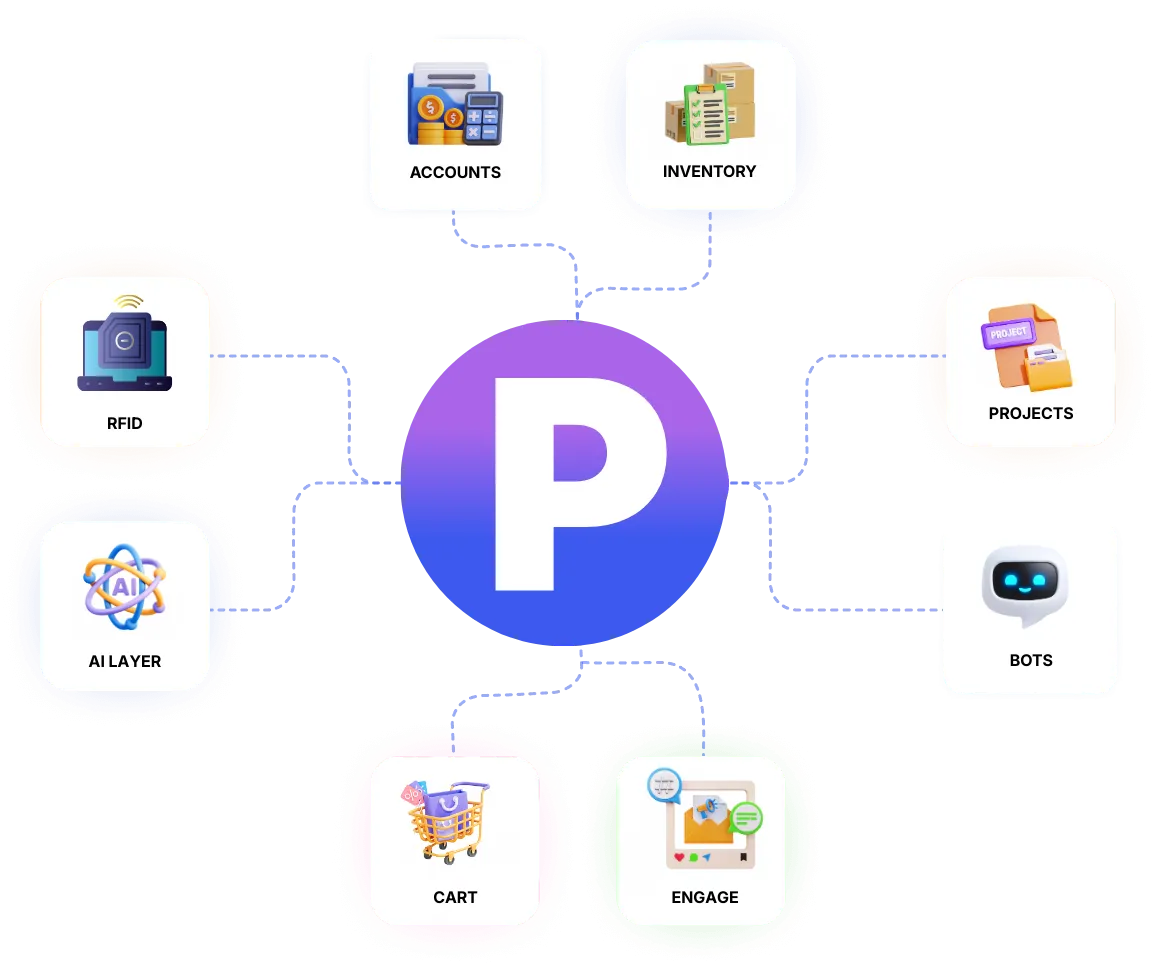
AI-Native Platform Referral Growth Pay on Milestones Met
AI-Powered Textiles and Leather Platform — Pixel Tech™
Your ROI

Your Expected ROI with Pixel ERP™ Textiles

Typical results teams see within the first year of going live.

28%

Less fabric waste

40%

Faster line throughput

99%

Lot & order traceability

6 mo

Average payback period

Exporters see margin recovered from less fabric waste, faster line balancing, and audit-ready compliance from day one.

AI IN NUMBERS

The measurable impact of AI on textile and leather operations.

Real results from Pixel-powered textile platforms running at textile factories, fabric mills, garment exporters, and fashion houses..

00%

Reduction in raw material waste through AI-optimized cutting plans, recipe management, and hide utilization algorithms

00%

Color consistency accuracy with AI recipe management across batches, seasons, and production runs

00%

Compliance documentation automated for LWG, REACH, ZDHC, Oeko-Tex, and international export certifications

00%

Buyer inquiries handled by multilingual WhatsApp AI BOTs in Japanese, Korean, Russian, and English

00%

Faster order-to-shipment cycle through AI production scheduling and predictive logistics optimization

00+

SKUs managed with RFID traceability from raw hide sourcing through tanning, finishing, and final export shipment
INDUSTRY CHALLENGES

Six challenges killing textile and leather profitability.

From inconsistent dyeing recipes to LWG audit nightmares, from dead stock in warehouses to lost export orders — the textile.

Recipe & Color Inconsistency

Textile factories and dyeing houses lose millions to color mismatches. A batch dyed in Delhi comes out differently in Tamil.

LWG, REACH & ZDHC Compliance

Environmental compliance is non-negotiable for international buyers. LWG Gold certification, REACH restricted substance.

Multilingual Export Communication

Indian textile factories and textile exporters serve buyers in Russia, Japan, Korea, Europe, and the Americas. Communication.

Raw Material Traceability Gaps

Where did this hide come from? What chemicals were used in the beam house? Which drum processed this batch?.

Dead Stock & Demand Forecasting

Textile warehouses are graveyards of overproduced fabric and finished leather that nobody ordered. Seasonal demand.

Digital Presence & Buyer Discovery

Textile factories and textile mills are production experts, not marketing companies. But today's buyers discover suppliers.

AI SOLUTIONS

Eight AI capabilities transforming textiles and leather.

Every capability is built into the Pixel Textiles platform — not bolted on. They share production data, learn.

AI Recipe Management

The brain of your textile factory. AI captures, standardizes, and optimizes every dyeing and tanning recipe. Historical recipe.

RFID Traceability

Every hide, every fabric roll, every finished piece — tracked from source to shipment. RFID tags attached at raw.

Compliance Automation

LWG Gold, REACH, ZDHC MRSL, Oeko-Tex, GOTS, BCI — each certification demands meticulous documentation. The AI.

Multilingual AI BOTs

WhatsApp BOTs that speak your buyers' languages. Japanese buyers get product inquiries answered in Japanese. Russian.

Demand Forecasting

AI analyzes historical order patterns, seasonal trends, buyer behavior, market signals, fashion forecasts, and raw.

Production Scheduling

AI-optimized production scheduling across multiple facilities. The system considers drum capacity, chemical.

Quality Inspection AI

Computer vision powered quality inspection that catches defects human eyes miss. Surface defects, color variations,.

Digital Buyer Portal

A branded buyer portal where international buyers browse your product catalog, view real-time inventory, request.

Production Process

From Fabric to Finished Garment

AI tracks every bundle through the line — cutting to packing — with real-time efficiency and quality visibility.

Design & Sampling

Tech packs, BOMs, and approved samples digitized; costing and consumption calculated per style.

Step 1
Step 2
Cutting

Markers laid and fabric cut in lays. Bundle tickets generated with size/colour breakdowns.

Stitching

Operation bundles routed to lines. AI tracks per-operator output, WIP, and line balancing.

Step 3
Step 4
Washing & Finishing

Washing, pressing, and finishing with lot tracking and shrinkage/quality monitoring.

QC & Packing

AQL inspection, measurement checks, then carton packing and dispatch with full lot traceability.

Step 5
AI-POWERED PRODUCTS

The Pixel arsenal for textiles and leather.

Five products working together as one intelligent textile platform. Shared production data, compound intelligence, and seamless.

Pixel ERP™

The core textile management platform. Recipe management, production planning, multi-facility coordination, quality.

Pixel Engage™ (Bots)

Multilingual WhatsApp BOTs for buyer engagement in Japanese, Korean, Russian, and English. Handle product inquiries,.

Pixel Inventory

RFID-powered inventory management from raw hide to finished export. Real-time visibility across all facilities..

Pixel Voice

AI-powered voice calls for buyer follow-ups, order confirmations, shipment notifications, and payment reminders..

Pixel IoT

Industrial-grade UHF RFID tags and readers designed for harsh textile factory environments. Chemical-resistant tags.

HOW WE COMPARE

Pixel Tech™ vs. the alternatives for textiles.

Not all textile technology is created equal. Here's how Pixel Tech™'s AI-native textile platform compares to legacy textile factory.

Capability Pixel Tech™ Legacy Textile factory Software Generic ERP (SAP/Tally) Big Consulting Build
AI Recipe Management ML-optimized with color prediction Basic recipe storage Not available Custom but expensive
RFID Traceability End-to-end hide-to-shipment RFID Barcode only Basic batch tracking Depends on scope
LWG Compliance 85% auto-generated documentation Manual documentation Not industry-specific Custom workflows
Multilingual BOTs Japanese, Korean, Russian, English Not available Not available Separate project
Demand Forecasting AI prediction 3-6 months ahead Historical reports only Basic MRP Custom analytics
Multi-Facility Coordination Real-time across 4+ locations Single-location focus Complex multi-site setup Expensive customization
Payment Model Pay on Milestones Met Upfront license Annual license + implementation Time & Materials
Delivery Lead Founder / Chief Architect Support Engineer Implementation Consultant Partner / Director
SUB-VERTICALS

AI intelligence for every textile and leather sub-vertical.

Whether you run a textile factory, fabric mill, garment export house, or fashion brand — our AI adapts to your specific production.

Textile factories & Leather Processing

AI recipe management for consistent dyeing and finishing across production runs. RFID traceability from raw hide.

  • AI recipe optimization for 98% color consistency
  • RFID hide-to-shipment traceability
  • LWG Gold compliance automation
Fabric Mills & Weaving Units

AI-optimized loom scheduling that maximizes output while minimizing changeover downtime. Yarn inventory management.

  • AI loom scheduling with changeover optimization
  • Computer vision fabric quality inspection
  • Predictive maintenance for weaving equipment
Garment Export Houses

End-to-end garment production management from fabric procurement to finished garment export. AI-optimized cutting plans.

  • AI cutting plans reduce fabric waste 35%
  • Sewing line balancing with operator efficiency tracking
  • Multi-buyer export documentation automation
Fashion Brands & Designers

Collection management with AI trend analysis and demand prediction. Digital product catalog with 3D visualization.

  • AI trend analysis for collection planning
  • Social media commerce integration
  • Customer analytics with demand prediction
How AI Transforms Your Textile Operations

From paper recipes to AI-powered production intelligence.

We study your entire textile operation — recipes, production flow, quality processes, compliance documentation,.

Textile Discovery & AI Strategy

We walk your production floor — beam house, tanning drums, dyeing units, finishing lines, quality stations.

Build, Configure & Demo Every 2 Weeks

Your textile platform is configured for your specific production processes, chemical formulations, and compliance.

Launch, Optimize & Get Smarter

Phased rollout starting with highest-impact modules — typically recipe management and RFID traceability first,.

REAL RESULTS

AI delivering measurable textile & leather results.

Real numbers from real textile operations running on Pixel-powered AI platforms. Every metric is verifiable. Every result.

Fabric Mill
Multi-Loom Weaving Operation

Deployed Pixel ERP™ with AI loom scheduling, computer vision quality inspection, and demand forecasting for a 200-loom.

  • Loom utilization increased from 72% to 91%
  • Fabric defect detection improved by 45%
  • Dead stock reduced by 38% with demand forecasting
  • Changeover time reduced by 25%
  • Energy consumption optimized by 18%
Read Full Case Study
Garment Exporter
Multi-Buyer Garment Export House

Deployed Pixel ERP™ with AI cutting optimization, sewing line balancing, and multi-buyer export documentation.


  • Fabric waste reduced by 35% with AI cutting plans
  • Sewing line efficiency improved by 28%
  • Export documentation time reduced by 70%
  • Buyer compliance audits passed first time
  • Order fulfillment accuracy improved to 99.2%
Read Full Case Study
AI Built by Enterprise Architects, Not IT Vendors

Every Recipe. Every Algorithm. Founder-Reviewed.

I'm Aman Jain — Founder, CEO & Chief Architect. With 25+ years at Bank of America, Merrill Lynch, Fidelity,.


Aman Jain — Founder & CEO, Pixel Tech™
FREQUENTLY ASKED QUESTIONS

Common questions about AI for textiles & leather.

Everything you need to know about AI-powered textile platforms — from recipe management and RFID traceability to LWG.

The AI analyzes thousands of historical dyeing and tanning records to understand how raw material characteristics (hide source, thickness, moisture content), environmental factors (temperature, humidity, water quality), and chemical formulations interact to produce specific color outcomes. When a new batch arrives, the system predicts the optimal recipe adjustments needed to match the target color. Cross-facility recipe synchronization ensures Delhi, Kolkata, Mumbai, and Tamil Nadu units produce identical results. Color matching accuracy reaches 98% compared to 82% with manual methods.

We use industrial-grade UHF RFID tags specifically designed for harsh chemical environments. These tags survive beam house processing, tanning drum immersion, dyeing baths, and finishing treatments. Tags are attached at raw material receipt and read at every production checkpoint. Long-range fixed readers at production station transitions. Handheld readers for quality inspection points. All integrated with Pixel ERP™ and Pixel Inventory for real-time visibility. The tags cost a fraction of the value they protect and enable buyer-facing traceability reports.

Pixel Engage™ (Bots) detect the buyer's language from their WhatsApp profile or initial message and respond accordingly. Japanese, Korean, Russian, and English are fully supported with industry-specific terminology. The BOT handles product availability inquiries, pricing requests, order status updates, shipping tracking, sample requests, and technical specification queries. Complex negotiations or complaints are escalated to your human export team with full conversation context and translation. Available 24/7 across all time zones — no more losing orders because of communication delays.

Absolutely. The platform automatically captures and documents all data required for LWG audits — chemical usage with MSDS compliance, water consumption per hide, effluent treatment records, energy consumption tracking, waste management documentation, and restricted substance monitoring. Audit readiness dashboards show your compliance score in real time against all LWG Gold criteria. Pre-audit checklists flag documentation gaps weeks before scheduled audits. our client maintained their LWG Gold certification with 50% less manual documentation effort after deployment.

Recipe management + RFID traceability for a single facility: 8-10 weeks. Adding compliance automation and demand forecasting: 12-16 weeks. Full multi-facility platform with multilingual BOTs and export documentation: 16-20 weeks. We recommend starting with the highest-impact module — usually recipe management or RFID traceability — and expanding from there. You see working software every two weeks throughout. Phased rollout minimizes production disruption.

We define clear milestones — "AI recipe management live with 95%+ color matching accuracy," "RFID traceability operational across all production stages," "LWG compliance documentation 80%+ automated." You pay only when milestones are delivered and verified by your production and quality teams. No annual licenses during build. If we don't hit the criteria, you don't pay. This is how confident we are in our textile AI — we bet our revenue on the results.

Yes. We integrate seamlessly with Tally, SAP Business One, and other accounting systems via APIs. Financial transactions, purchase orders, sales invoices, and inventory movements sync automatically. You don't need to replace your accounting system. Pixel ERP™ handles production intelligence — recipes, scheduling, traceability, compliance — while your existing financial system handles accounting. Dual data entry eliminated. Financial reports reconcile automatically.

The AI analyzes your historical order data, buyer patterns, seasonal trends, market signals, fashion trend indicators, and raw material price movements. It predicts demand 3-6 months ahead per SKU category. Production planning shifts from reactive to proactive. The system recommends optimal production quantities considering lead times, capacity constraints, and buyer-specific preferences. Dead stock reduced by 40%. Rush orders reduced by 55%. Your capital stays in production, not in warehouses full of unsold inventory.

Yes. The platform manages compliance documentation for multiple frameworks simultaneously — LWG, REACH restricted substance lists, ZDHC MRSL (Manufacturing Restricted Substances List), Oeko-Tex, GOTS, and BCI. Chemical inventory is cross-referenced against all applicable restricted substance lists. Any chemical approaching a restricted threshold triggers alerts. Documentation for each certification is generated from the same operational data — no duplicate data entry. One platform, multiple compliance frameworks, automatic documentation.

The AI provides real-time capacity visibility across all your facilities — Delhi, Kolkata, Mumbai, Tamil Nadu, or wherever you operate. Production scheduling considers each facility's equipment, chemical availability, labor, and current load. Orders are routed to the optimal facility based on capacity, capability, and delivery timeline. Inter-facility transfers are managed with documentation. Recipe synchronization ensures consistent output regardless of which facility produces the order. One dashboard shows all facility schedules, capacity, and production status.

Yes. 100%. Upon full payment, all custom code, AI models, recipes, and configurations belong to you. Deployed on your infrastructure. All production data, recipe formulations, and buyer information stays in your environment — always. No vendor lock-in. No per-user licensing. You can take the entire platform and manage it yourself. Your recipe formulations are your most valuable IP — they never leave your control.

High-resolution cameras at quality inspection stations capture images of every piece — leather surface, fabric construction, garment finish. AI models trained on your specific product types and quality standards detect surface defects, color variations, texture inconsistencies, grain pattern anomalies, and dimensional deviations. Each piece is graded automatically with photographic evidence stored for buyer reference. Defect pattern analysis identifies root causes — which machines, materials, or processes are causing specific defect types.

Absolutely. The digital buyer portal provides a branded product catalog in Russian for IFLPS Moscow attendees. QR codes at your booth link buyers directly to product details, certifications, and sample request forms — all in Russian. The WhatsApp BOT handles post-show follow-ups in Russian automatically. Lead capture from the trade show feeds into your CRM. Product samples are tracked from request through production and shipment. Your IFLPS presence becomes a 365-day engagement channel, not just a 3-day booth.

Legacy textile factory software stores recipes but doesn't optimize them. Generic ERPs like SAP don't understand beam house chemistry or LWG audit requirements. We build AI-native textile platforms where recipe optimization, RFID traceability, compliance automation, and multilingual buyer engagement work as one integrated system. AI trained on YOUR production data. Our founder (25+ years at Wall Street firms) personally architects every system. Pay on milestones met. You own the code. No per-user licensing.

Yes. The digital buyer portal integrates with your Facebook and Instagram presence. Product catalog sync ensures your social media showcases your latest collections automatically. AI-powered content suggestions based on buyer engagement patterns. Social media leads are captured and routed into your CRM with automated follow-up sequences. Performance analytics show which products and content types drive the most buyer engagement. Your production quality deserves a digital presence that matches.

The platform integrates with ETP (Effluent Treatment Plant) monitoring systems — pH sensors, TDS meters, flow meters, and BOD/COD analyzers. Real-time effluent quality monitoring with automated alerts when parameters approach regulatory limits. Historical data logging for compliance reporting. Predictive maintenance for ETP equipment based on performance trends. All ETP data feeds into LWG and environmental compliance documentation automatically. Zero manual data collection for environmental monitoring.

The AI considers seasonal patterns, fashion cycle timing, buyer ordering history, and market signals to generate demand curves per product category. Pre-season production recommendations optimize capacity utilization during slow periods. Rush season capacity is pre-allocated based on predicted order volumes. Raw material procurement is timed to take advantage of price cycles while ensuring availability during peak demand. The result: smoother production flow, less overtime, less dead stock, and consistent delivery performance year-round.

Yes. The system generates packing lists, commercial invoices, certificates of origin, shipping bills, bills of lading, and country-specific compliance documents automatically from order and production data. Country-specific documentation requirements for Russia, Japan, Korea, and EU markets are pre-configured. Customs tariff code suggestions based on product classification. Export documentation time reduced by 70%. Your logistics team processes shipments in hours instead of days.

Textile AI systems need continuous nurturing — recipe models retrain as new raw material sources are introduced, compliance requirements evolve, and buyer specifications change. We offer managed services: 24/7 monitoring, monthly AI accuracy reports, quarterly recipe model reviews, compliance update implementation, and feature enhancements. But you're never locked in. You own the code and can self-manage whenever you choose. Most textile clients choose managed services because AI systems perform best with expert attention.

Yes. The platform is modular — start with the highest-impact capability (usually recipe management or RFID traceability) and expand as ROI is proven. Pay on milestones met means zero upfront capital risk. A small textile factory might start with recipe management and compliance automation for a fraction of what SAP implementation costs. The AI pays for itself through waste reduction, consistency improvement, and compliance efficiency. We've designed the pricing to make AI accessible to mid-market textile businesses, not just large corporations.
RELATED INDUSTRIES

AI powers every industry we serve.

Textiles & leather AI is one part of the Pixel Ecosystem. Explore how we deploy intelligence across other industries.

AI-powered production planning, quality inspection via computer vision, predictive maintenance, RFID-powered inventory.

Explore Manufacturing

AI-powered warehouse management, route optimization, WhatsApp-powered dealer engagement, demand forecasting.

Explore Distribution

Ready to make your textile operations intelligent?

Tell us your biggest challenge — recipe consistency, LWG compliance, buyer communication, production scheduling.