


The intelligent core that runs your business — production, inventory, accounting, procurement, and projects in one adaptive platform that learns your operations and gets smarter every day it runs.
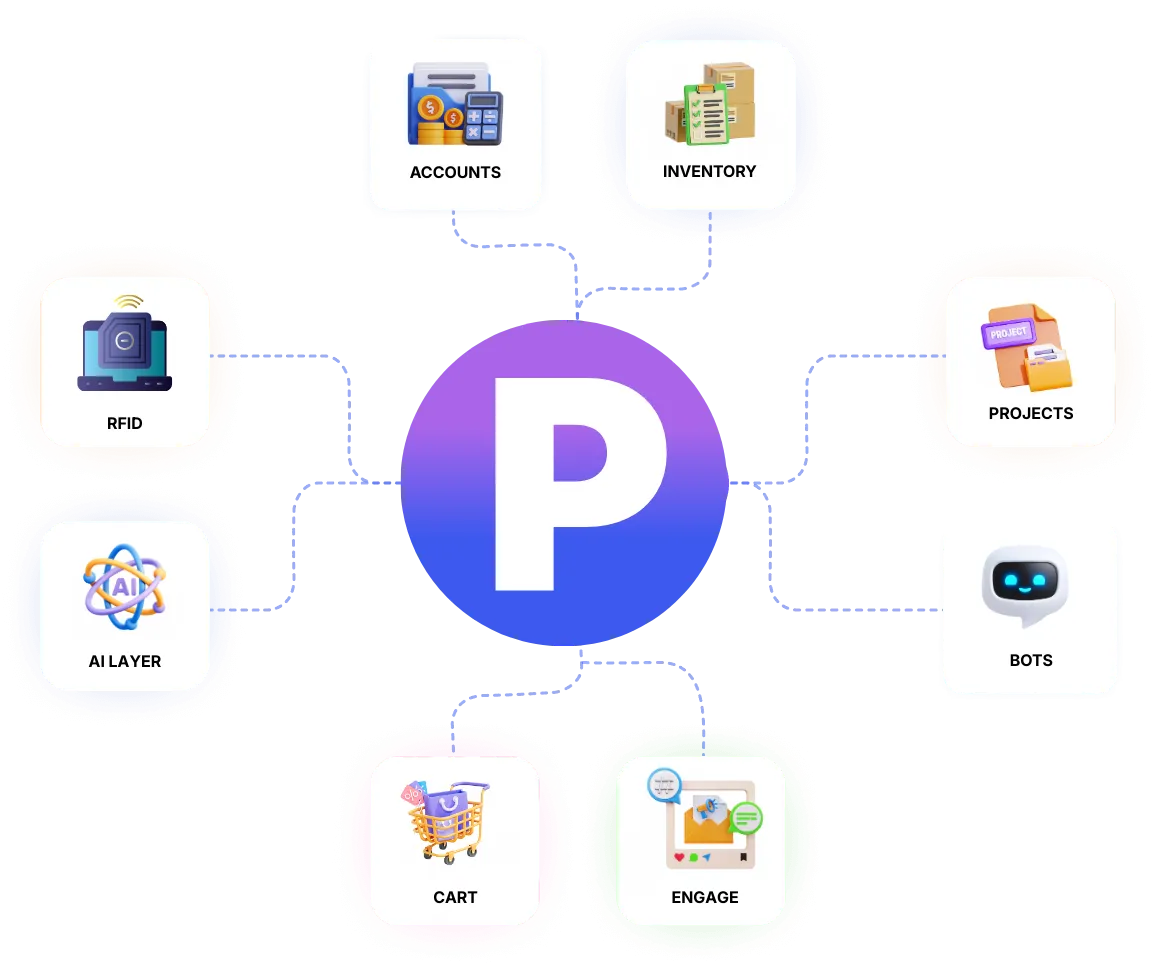
Pixel ERP™ ships with eight deeply integrated modules — each powered by AI, each configurable, each adapting to your industry.
From lead capture to order fulfillment, the Sales module automates your entire revenue pipeline. AI-powered pipeline.
Automate procurement from requisition to payment. AI analyzes vendor performance, predicts optimal reorder points.
Real-time inventory visibility across every warehouse and location. AI demand forecasting predicts what you'll need.
Streamline inbound logistics with AI-powered quality checks, automated three-way matching (PO, GRN, invoice).
Handle customer and vendor returns with intelligent classification, automated restocking decisions, and real-time.
Complete financial management with automated journal entries, trial balance, P&L statements, and balance sheets..
Gamify your business operations with AI-powered tournaments, team leaderboards, and performance scoring. Sales teams.
The industry's first voice-and-text-to-proposal system. Sales reps speak or type a brief description of what.
Pixel ERP™ is AI-native from the ground up. Every module, every workflow, every decision point is augmented by machine learning.
Every form in Pixel ERP™ is defined by schema stored in scalable cloud database — never hardcoded, never exposed.
Built for SaaS from day one. Company-scoped data isolation ensures every tenant's data is completely segregated.
Every transaction feeds AI models that predict revenue trends, demand patterns, vendor performance, and operational bottlenecks..
AI doesn't just analyze — it acts. Routine approvals are auto-processed when they match learned patterns. Purchase orders are.
The breakthrough feature that sales teams love. A rep records a 30-second voice note or types a brief description: "3000 sq ft.
Because all modules share the same data layer, AI sees connections that siloed systems miss. A spike in returns triggers quality.
See how Pixel ERP™'s AI-native, configurable architecture compares to legacy ERP systems and the spreadsheet chaos most.
| Capability | Spreadsheets | Traditional ERP | Pixel ERP™ |
|---|---|---|---|
| Form Customization | Manual templates | Costly customization | Configurable (scalable cloud database schema) |
| AI Intelligence | None | Bolt-on modules | Native in every module |
| Multi-Tenant | Separate files | Separate instances | Company-scoped data isolation |
| Proposal Generation | Manual (hours) | Template-based (30 min) | Chat-to-Proposal ML (60 seconds) |
| Query Flexibility | Filter/sort | Pre-built reports | GSI-powered flexible querying |
| Gamification | None | None | Tournament leaderboards built-in |
| Deployment Time | Instant (but chaos) | 6-18 months | 8-12 weeks (full implementation) |
| Scalability | Breaks at scale | Expensive scaling | Scalable Cloud Database auto-scaling |
| Integration | Copy-paste | Middleware required | Native Pixel Ecosystem |
| Customization Cost | Free (but manual) | $50K-$500K per change | Config change (zero code) |
| Financial Intelligence | Manual analysis | Basic reporting | AI anomaly detection + forecasting |
| Mobile Access | Limited | Clunky mobile | Mobile-first responsive design |
As part of the Pixel Ecosystem, Pixel ERP™ doesn't operate in isolation. It's the operational backbone that every other product.
Every ERP transaction auto-generates accounting entries in Pixel Accounts. Sales create receivables, purchases create.
Bi-directional sync between ERP and Pixel Inventory. Sales orders reserve stock, purchase orders create expected.
Pixel Engage™ (Bots) uses ERP as its data backbone. When customers ask about order status, pricing, or availability.
E-commerce orders from Pixel Cart™ flow directly into ERP as sales orders. Pricing, discounts, and promotions sync.
B2B orders from Pixel Trade Portal create ERP sales orders with customer-specific pricing, credit terms, and approval.
Pixel IoT feeds real-time location and movement data into ERP for goods receipt verification, warehouse management.
Because Pixel ERP™ is configurable, it adapts to any industry's unique workflows, terminologies, and regulatory requirements —.
Production planning, BOM management, work order tracking, quality control, and machine scheduling. AI optimizes.
Fabric production tracking (greige to finished), dyeing lot management, quality grading, and export documentation. AI.
Multi-warehouse management, route optimization, dealer management, and credit control. AI predicts demand by territory,.
POS integration, multi-store management, customer loyalty programs, and seasonal planning. AI-powered merchandising,.
Project billing, resource allocation, timesheet management, and client management. AI-powered resource matching,.
Every Pixel ERP™ implementation follows our proven methodology — founder-led, milestone-gated, and designed to deliver measurable.
We map your current processes, identify automation opportunities, and define the configurable schema for every module..
dynamic forms, workflows, and approval chains are defined in scalable cloud database. Industry templates provide 80%.
Historical data is migrated with AI-assisted mapping and validation. Tally ERP XML integration bridges your existing accounting..
ML models are trained on your historical data — demand patterns, pricing history, approval behaviors, vendor performance..
Your team validates every module against real business scenarios. We run parallel operations with your existing system. AI.
Phased rollout with real-time monitoring. AI models continuously optimize based on live data. Monthly reviews track KPIs against.
Every Pixel ERP™ implementation is personally overseen by our founding team — not outsourced to junior developers or offshore.
CEO & Chief Architect
25+ years building enterprise systems at Bank of America, Merrill Lynch, and Fidelity Investments. Aman personally.
CTO
16+ years at Accenture delivering large-scale technology transformations for global enterprises. Garima leads.
Three fundamental differences: (1) Configurable architecture — every form and workflow is defined by schema in cloud-native.
In traditional ERPs, forms, fields, and workflows are hardcoded into the application. Adding a field means hiring a developer,.
A sales rep records a voice note or types a text description of the customer's needs — for example, "Client needs 5000 sqft.
Pixel ERP™ uses scalable cloud database's partition key architecture for data isolation. Every record includes a company.
Every module includes AI capabilities: Sales — Chat-to-Proposal ML, pipeline scoring, deal closure prediction. Purchases — vendor.
Pixel ERP™ integrates with Tally ERP through bi-directional XML sync via Pixel Accounts. Bills receivable, bills payable, ledger.
Pixel ERP™ includes a gamification engine that turns business operations into engaging competitions. Create sales tournaments.
A typical implementation takes 8-12 weeks across 6 phases: Discovery (1-2 weeks), Schema Configuration (2-3 weeks), Data.
Our milestone-based billing means you pay only when we deliver measurable results — not upfront, not by the hour, and not.
Yes. Pixel ERP™ supports multi-currency transactions with real-time exchange rate feeds, automatic gain/loss calculations.
Pixel ERP™ is built with enterprise-grade security at every layer: AES-256 encryption for all data at rest and in transit,.
Yes. We have proven migration processes for Tally ERP, SAP Business One, Oracle NetSuite, Zoho, and custom/legacy systems. Our.
Pixel ERP™ is built on scalable cloud database, which provides virtually unlimited auto-scaling. As your transaction volume.
Our clients typically see: 40% reduction in manual data entry through AI automation, 25% improvement in inventory turns.
Absolutely — and this is where the configurable architecture truly shines. Industry-specific templates cover 80% of requirements.
No. Pixel ERP™ is designed for business users, not developers. The admin dashboard lets non-technical team members manage users,.
Pixel ERP™ integrates natively with Pixel IoT for automated goods receipt, inventory counting, and asset tracking. When tagged.
Pixel ERP™ includes comprehensive AI-powered analytics: real-time dashboards for every module (sales, purchases, inventory,.
Five reasons: (1) AI-native architecture — intelligence is built into every module, not bolted on as an afterthought. (2).
Absolutely. We offer personalized demos where we show Pixel ERP™ configured for your specific industry and workflows. During.
Join the businesses that have transformed their operations with Pixel ERP™. From built-in flexibility.
AI-powered adaptive ERP represents the next evolution of enterprise resource planning. Unlike traditional ERPs that force.
AI and automation are transforming every aspect of enterprise operations. From predictive demand forecasting that prevents.
At Pixel Tech™, we've embedded AI into every module of Pixel ERP™ because we believe intelligence should be native, not an add-on..
Pixel ERP™ is part of the broader Pixel Ecosystem, connected through our hub-and-spoke architecture. This means your ERP natively.
Whether you're in manufacturing, natural stone, textiles, distribution, retail, or professional services, Pixel ERP™ adapts.