
AI-Powered Manufacturing.

Pixel Tech™ builds AI-native manufacturing solutions that transform every aspect of industrial operations — from.
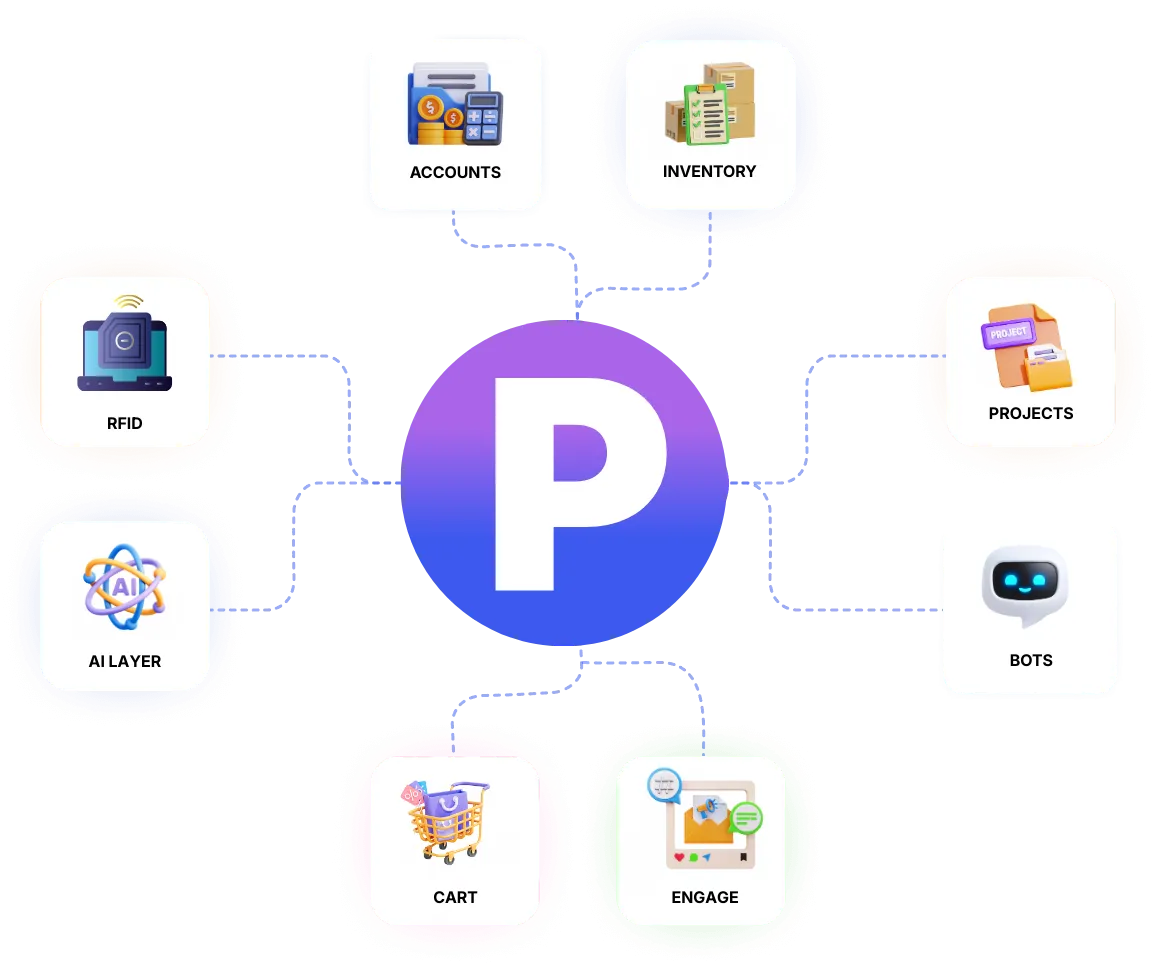
Pixel Tech™ AI-Powered Manufacturing Solutions for Industrial Production
Your ROI

Your Expected ROI with Pixel ERP™ Manufacturing

Typical results teams see within the first year of going live.

35%

Less unplanned downtime

45%

Faster production cycles

99%

Inventory accuracy

5 mo

Average payback period

Most plants recover their investment in under two quarters through higher throughput, lower scrap, and tighter inventory control.

0%

Reduction in Manual Processes

0x

Faster Field Service Response

0%

Reduction in Overproduction

0%

Referral-Based Growth

0+

Ecosystem Products

0

Pay on Milestones Met
Challenges We Solve

Six Critical Manufacturing Challenges
That AI Eliminates

Manufacturers face challenges that generic software can't address — from unpredictable production bottlenecks and quality escapes.

Production Bottlenecks & Scheduling Chaos

Manual production scheduling leads to resource conflicts, missed deadlines, and idle capacity. AI analyzes historical production.

Quality Escapes & Inconsistent Inspection

Human inspectors miss defects, especially under production pressure. AI-powered quality control uses computer vision to inspect.

Inventory Blind Spots & Stockouts

Manufacturers carry excess inventory to avoid stockouts, tying up capital. Or they run lean and face production stops when parts.

Fragmented Supply Chain Visibility

When your supply chain spans multiple vendors, warehouses, and logistics partners, visibility breaks down. Critical components.

Unplanned Equipment Downtime

A single machine failure can halt an entire production line. Reactive maintenance costs 3-5x more than preventive maintenance. AI.

Disconnected Field Service Operations

Industrial equipment manufacturers don't just build — they service, install, and maintain equipment in the field. Paper-based.

AI Capabilities

Eight AI-Powered Manufacturing
Capabilities That Transform Operations

Every capability below is production-deployed AI — not a roadmap item or beta feature. These are the same systems running in real.

Production Planning

AI Production Planning & Scheduling

AI analyzes order pipelines, machine capacity, workforce availability, material lead times, and historical production.

  • Multi-line production optimization
  • Dynamic re-scheduling on disruptions
  • Capacity utilization AI models
Quality Control

AI Quality Inspection & Defect Detection

Computer vision systems inspect products at production speed, identifying surface defects, dimensional deviations, weld.

  • Computer vision defect detection
  • Dimensional variance analysis
  • Weld and assembly quality scoring
Inventory & RFID

RFID-Powered Inventory & WIP Tracking

RFID tags on raw materials, work-in-progress assemblies, and finished goods provide real-time visibility.

  • UHF RFID tags on all inventory classes
  • Real-time WIP tracking per station
  • AI demand forecasting and auto-reorder
Supply Chain

AI Supply Chain Intelligence

Monitor vendor performance, predict delivery delays, flag quality risks in incoming batches, and automatically trigger.

  • Vendor performance AI scoring
  • Delivery delay prediction models
  • Incoming batch quality analytics
Equipment Maintenance

Predictive Maintenance & Asset Management

AI analyzes vibration signatures, temperature readings, power consumption anomalies, and maintenance history to predict.

  • IoT sensor data analysis
  • Failure prediction 2-4 weeks ahead
  • Maintenance window optimization
Shop Floor Automation

Shop Floor Digitization & Automation

Replace paper-based shop floor processes with digital work orders, real-time production tracking, and automated.

  • Digital work orders and BOMs
  • Real-time production dashboards
  • Operator efficiency analytics
ERP Integration

AI-Powered Manufacturing ERP

Pixel ERP™ for manufacturing isn't a generic ERP with an industry label. It's purpose-built with manufacturing-specific.

  • Multi-level BOM management
  • Production costing (actual vs standard)
  • Tally XML API real-time sync
Field Service

AI Field Service & Service App

Industrial equipment manufacturers don't just sell — they install, service, inspect, and maintain equipment.

  • Mobile-first service app (offline capable)
  • AI route optimization for technicians
  • Parts inventory and pre-dispatch checks
Production Process

From Raw Material to Dispatch

A connected shop floor — every work order tracked from material issue to finished-goods dispatch.

Production Planning

Demand and orders converted to work orders; AI schedules capacity, materials, and routings.

Step 1
Step 2
Material Issue

Raw materials issued against BOM with batch/lot tracking and real-time stock deduction.

Shop-Floor Execution

Operations tracked by machine and operator; AI flags bottlenecks and downtime live.

Step 3
Step 4
Quality Control

In-process and final QC with rejection tracking and rework loops linked to each batch.

Finished Goods & Dispatch

FG receipt, packing, and dispatch with full genealogy from raw material to shipment.

Step 5
Pixel Ecosystem

The Pixel Ecosystem Products That
Power Manufacturing Operations

Manufacturing doesn't happen in isolation — production connects to inventory, inventory connects to procurement, procurement.

Pixel ERP™

Core manufacturing ERP with production orders, multi-level BOM, work center scheduling, quality management, and costing — all AI-optimized.

Pixel Inventory

AI-optimized inventory with RFID integration, demand forecasting, automated reordering, multi-warehouse support, and WIP tracking.

Pixel IoT

End-to-end RFID solutions with UHF handheld readers, fixed readers, industrial tags, middleware, and AI analytics for real-time asset tracking.

Pixel Accounts

Intelligent financial management with AI invoice processing, Tally integration, GST/TDS compliance, and production costing reconciliation.

Pixel Service

AI-powered helpdesk and field service management with technician dispatch, job tracking, parts management, and equipment lifecycle monitoring.

Pixel Engage™ (Bots)

WhatsApp chatbots for dealer order capture, service request intake, delivery status updates, and customer engagement — AI-powered.

Pixel Engage™

Marketing automation for manufacturers — AI-segmented dealer campaigns, product launch communications, and lead nurturing.

Comparison

Manual Processes vs Generic ERP vs Pixel AI Manufacturing

Most manufacturers are stuck between paper-based processes and generic ERP systems that weren't built for manufacturing.

CapabilityManual / SpreadsheetsGeneric ERPPixel AI Manufacturing
Production SchedulingManual whiteboards and Excel, frequent conflictsStatic MRP runs, requires manual adjustmentsAI dynamic scheduling, auto-adjusts on disruptions in real time
Quality ControlHuman visual inspection, inconsistent and slowDigital checklists, still manual inspectionAI computer vision, 100% inspection at production speed
Inventory TrackingMonthly physical counts, always inaccurateBarcode scanning, data entry delaysRFID real-time tracking with AI demand forecasting
Supply Chain VisibilityPhone calls and emails to vendorsPurchase order tracking, no intelligenceAI vendor scoring, delay prediction, auto-alternative sourcing
Equipment MaintenanceReactive — fix when it breaksCalendar-based preventive schedulesAI predictive maintenance, IoT sensor analysis, 2-4 weeks advance warning
Field ServicePaper service logs, no trackingBasic ticketing systemAI-powered mobile app, route optimization, predictive service needs
Financial IntegrationManual data entry into TallyScheduled exports, data lagReal-time Tally XML API sync — invoices, vouchers, ledgers, GST
BOM ManagementSpreadsheets with version confusionSingle-level BOM onlyMulti-level BOM with cost rollup and substitution intelligence
Reporting & AnalyticsManual Excel reports, days to compileStandard reports, limited customizationAI-generated insights, predictive dashboards, anomaly alerts
Exhibition Product ShowcasePrinted catalogs, outdated on arrivalNot availableDigital exhibition app with real-time product catalog and lead capture
Pricing ModelN/APer-user licensing, vendor lock-inMilestone billing, your infrastructure, zero lock-in
AI CapabilitiesNonePremium add-on (extra cost)Built into every layer — AI is the architecture, not an add-on
Manufacturing Verticals

Six Manufacturing Sub-Industries
We Serve with AI Solutions

Manufacturing is not one industry — it's dozens. A discrete manufacturer assembling safety equipment has fundamentally different.

Discrete Manufacturing

Discrete & Assembly Manufacturing

AI solutions for manufacturers assembling distinct products — from industrial safety equipment (boom lifts, scissor.

  • Multi-level BOM with substitution intelligence
  • Assembly line sequencing AI
  • RFID WIP tracking per station
Process Manufacturing

Process & Batch Manufacturing

AI solutions for process manufacturers where products are made through formulas and recipes — chemicals, paints,.

  • AI batch optimization and formula management
  • Real-time process parameter monitoring
  • Yield optimization across batches
Industrial Equipment

Industrial & Safety Equipment

Our flagship vertical — AI solutions for companies manufacturing and servicing industrial safety equipment.

  • Equipment certification and safety compliance
  • Exhibition App for trade show catalogs
  • Service App for field technicians
Automotive Parts

Automotive Parts & Components

AI solutions for automotive parts manufacturers — from precision machined components to stamped parts, castings.

  • PPAP and APQP compliance automation
  • AI-powered SPC with anomaly detection
  • Full traceability from raw to installed
Chemicals

Chemicals & Specialty Materials

AI solutions for chemical manufacturers managing complex formulations, hazardous material compliance, batch.

  • AI formulation and reaction optimization
  • Hazardous material compliance (MSDS/GHS)
  • Environmental monitoring and reporting
Food Processing

Food Processing & Packaging

AI solutions for food processors managing perishable inventory, batch recipe management, allergen tracking, FSSAI.

  • AI perishable inventory optimization
  • FSSAI compliance and allergen tracking
  • Cold chain IoT monitoring
Implementation

Six-Phase AI Manufacturing
Implementation Process

Every Pixel manufacturing implementation follows a proven six-phase process that de-risks deployment and delivers working.

Manufacturing Discovery

Deep dive into your manufacturing operations — production workflows, quality processes, inventory management, supply chain, field.

Phase 1
Phase 2
Core ERP & Production

Deploy the core manufacturing ERP — production orders, BOM management, work center configuration, inventory setup, and Tally.

AI & Intelligence Layer

Deploy AI capabilities — production scheduling optimization, quality control vision, demand forecasting, supply chain.

Phase 3
Phase 4
Apps & Customer Systems

Deploy customer-facing and field systems — Service App for field technicians, Exhibition App for trade show product catalogs,.

Optimization & Scale

AI models are continuously refined based on production feedback. Advanced analytics dashboards are deployed for executive.

Phase 5
Proven Results

Measurable Manufacturing Transformation Results

These are real results from real manufacturing deployments — not projections or industry averages. Our milestone-based billing.

0%

Reduction in Manual Processes

0%

Overproduction Reduction

0x

Faster Field Service Response

0%

Inventory Accuracy with RFID

0%

Reduction in Equipment Downtime

0%

Faster Order Processing

0%

Reduction in Inventory Carrying Cost

0%

Faster Trade Show Lead Capture
Founder-Led Manufacturing Expertise

Enterprise Architects Who Understand
Manufacturing Operations

When you engage Pixel Tech™ for a manufacturing solution, you work directly with our founders — the same people.

Aman Jain — CEO & Chief Architect

25+ years building enterprise-grade systems at Bank of America, Merrill Lynch, and Fidelity. Personally architects.

Garima Jain — CTO

16+ years delivering technology transformations at Accenture for Fortune 500 clients across industries. Leads quality assurance,.

Pixel Tech™ Founders - Manufacturing Expertise
FAQ

Frequently Asked Questions About
AI-Powered Manufacturing Solutions

We serve all major manufacturing sub-verticals: discrete manufacturing (assembly, machining, fabrication), process manufacturing (chemicals, paints, batch production), industrial safety equipment (boom lifts, scissor lifts, scaffolding, fall protection, aerial work platforms), automotive parts and components, chemical and specialty materials, and food processing. Our deepest expertise is in industrial safety equipment manufacturing, built through real-world deployments with companies like our client Group managing boom lifts, scissor lifts, scaffolding, MEWP, mobile lighting, and porta deck operations.

AI analyzes historical production data, current order pipeline, machine capacity, workforce availability, material lead times, and maintenance schedules to generate optimized production plans. Unlike static MRP runs, AI continuously re-optimizes when disruptions occur — rush orders, machine breakdowns, material delays. For a manufacturer running multiple product lines simultaneously (boom lifts on one line, scissor lifts on another, scaffolding on a third), AI ensures zero resource conflicts while maximizing throughput. Result: 30-40% improvement in capacity utilization.

Pixel IoT provides end-to-end solutions including UHF handheld readers, fixed readers for dock doors and production lines, industrial-grade tags rated for metal surfaces and harsh environments, middleware for real-time data processing, and AI analytics. In manufacturing, RFID tracks raw materials from receiving dock to production, WIP components through each production station, and finished goods through shipping. Integration with Pixel ERP™ means inventory counts are always real-time — no more physical counts or barcode scanning delays.

Yes — Tally integration is a core capability. We connect via Tally's XML API for real-time synchronization of trial balances, bills receivable and payable, journal entries, ledger summaries, payment vouchers, and GST reports. This means your accounting team continues using Tally for financial management while Pixel ERP™ handles production, inventory, quality, and operations. Data flows automatically in both directions — no manual data entry, no reconciliation headaches, no data lag between systems.

The Pixel Exhibition App is a digital product catalog application used at trade shows and exhibitions. For industrial equipment manufacturers, it replaces printed catalogs with an interactive digital experience — visitors can browse your full range of boom lifts, scissor lifts, scaffolding, fall protection equipment, aerial work platforms, and mobile lighting towers with specifications, images, videos, and pricing. Leads are captured digitally with AI qualification scoring. The app works offline (essential at exhibition venues with poor WiFi) and syncs when connected. our client Group uses this at major industrial trade shows.

The Pixel Service App is a mobile application for field service technicians. Engineers access their job schedule, navigation to customer sites, complete equipment service history, service manuals and knowledge bases, parts inventory at their vehicle/warehouse, and digital service report forms. AI optimizes route planning to minimize travel time and ensures the right parts are loaded before dispatch. Supervisors see real-time field engineer locations and job status. Used by our client Group's service team for maintaining boom lifts, scissor lifts, and safety equipment across multiple customer sites.

A focused manufacturing module (RFID inventory, field service app, exhibition app) takes 4-8 weeks. A core manufacturing ERP with production management, inventory, and accounting integration takes 8-12 weeks. A full AI manufacturing ecosystem with quality vision, predictive maintenance, supply chain intelligence, and all mobile apps takes 16-24 weeks delivered in phases. Working software is deployed every 2-3 weeks so you see value immediately — AI models improve continuously as they train on your production data.

Before work begins, we define milestones with specific, measurable acceptance criteria. Example milestones for a manufacturing project: (1) Core ERP with BOM management and production order workflow — acceptance: 10 real production orders processed successfully. (2) RFID inventory deployed — acceptance: 99%+ accuracy on physical audit. (3) AI production scheduling — acceptance: demonstrated 20%+ capacity utilization improvement. You test each milestone against criteria. If it passes, payment is triggered. If it doesn't, we fix it first. This eliminates your risk completely.

Yes — with sufficient data. AI predictive maintenance models analyze patterns in vibration data, temperature readings, power consumption, acoustic signatures, and historical maintenance records to identify early warning signs of failure. Machine learning detects subtle changes that human operators miss. For example, a CNC machine's spindle bearing may show micro-vibration changes 3-4 weeks before failure. AI catches this, schedules maintenance during planned downtime, and avoids catastrophic production stops. Accuracy improves continuously as the model learns your specific equipment behavior.

Yes — multi-level BOM with unlimited nesting levels. A boom lift might have a top-level BOM that includes sub-assemblies (hydraulic system, chassis, platform, controls), each of which has its own BOM with components and raw materials. Pixel ERP™ manages this entire structure with version control, engineering change orders (ECOs), cost rollup, and AI-powered substitution intelligence that suggests alternative components when preferred parts are unavailable or delayed. The system tracks both planning BOMs and manufacturing BOMs for the same product.

AI quality control uses cameras positioned at inspection points on the production line. Computer vision models are trained on images of good and defective products specific to your manufacturing. The system learns what surface defects, dimensional variances, weld quality issues, paint inconsistencies, and assembly errors look like for your exact products. During production, every unit is photographed and analyzed in milliseconds. Defects are flagged in real time with classification (type, severity, location). For safety equipment manufacturers, this ensures 100% inspection at production speed — critical when defects can be life-threatening.

Absolutely. The Pixel Ecosystem is modular by design. Most manufacturing clients start with the highest-impact module — often RFID inventory tracking, core ERP, or the field service app — and expand as they see value. Every product connects seamlessly with others through the shared data layer. Starting with RFID inventory and later adding production scheduling means the scheduler automatically uses real-time inventory data. The hub-and-spoke architecture ensures each addition multiplies the value of existing modules rather than requiring re-integration.

We follow a proven data migration methodology: (1) Audit existing data sources — ERP, spreadsheets, Tally, legacy databases. (2) Design migration mapping — which fields map where, transformations needed, data quality rules. (3) Build automated ETL pipelines with validation checkpoints. (4) Run parallel testing with your team validating migrated data. (5) Execute production cutover with documented rollback plan. AI-powered validation catches data inconsistencies that manual review misses. For manufacturing, we specifically migrate BOMs, production orders, inventory records, customer/vendor masters, and financial data.

Based on real manufacturing deployments: 60% reduction in manual processes, 40% reduction in overproduction through AI demand forecasting, 3x faster field service response, 99%+ inventory accuracy with RFID (from typical 80-85%), 35% reduction in unplanned equipment downtime, 45% faster order processing, and 50% reduction in inventory carrying costs. ROI typically exceeds investment within 6-9 months. The milestone billing model means you validate these improvements before each payment — making ROI verification built into the engagement structure.

Yes. Unlike SaaS vendors who require their cloud, Pixel products deploy on your infrastructure — AWS, Azure, GCP, or on-premise servers. You control your data, your scaling, and your costs. No multi-tenant risks, no vendor lock-in, and no per-user licensing that penalizes growth. For manufacturing companies with sensitive production data, intellectual property, or compliance requirements, infrastructure ownership is non-negotiable. We provide full source code access and knowledge transfer so your team can maintain the system independently.

AI supply chain intelligence monitors vendor performance across multiple dimensions — on-time delivery rates, quality rejection rates, pricing trends, responsiveness, and capacity utilization. Machine learning models predict delivery delays by analyzing historical patterns, seasonal factors, and external signals. When a delay is predicted, the system automatically identifies alternative suppliers from your approved vendor list, compares pricing and lead times, and presents options — or auto-triggers procurement if rules permit. For incoming materials, AI analyzes batch quality data to flag potential issues before materials enter production.

Every deployment includes comprehensive, role-based training: shop floor operators learn digital work orders and RFID scanning. Production supervisors learn scheduling tools and dashboards. Quality inspectors learn vision system operation and defect classification. Field engineers learn the Service App and mobile procedures. Management learns analytics dashboards and AI-generated insights. Training materials include video walkthroughs, quick-reference cards, and hands-on workshops. Post-training support ensures your team is fully confident before transition to managed services.

Security at every layer: AES-256 encryption at rest, TLS 1.3 in transit, SHA256 authentication, role-based access controls (RBAC), comprehensive audit logging, multi-factor authentication (MFA), and SSO integration. Manufacturing-specific security includes IP protection for BOM data, segregated access for production vs. financial data, and VPC-isolated infrastructure. Regular security audits and penetration testing reports are provided. Since the system deploys on your infrastructure, your IT team controls network security, firewall rules, and data residency.

Yes. Pixel Engage™ (Bots) supports manufacturing-specific WhatsApp bot configurations: dealer order capture bots (dealers send orders via WhatsApp, AI processes them into ERP), service request bots (customers request maintenance via WhatsApp, AI creates service tickets and dispatches technicians), delivery status bots (customers check shipment status via WhatsApp), and equipment inquiry bots (prospects ask about boom lift specifications, AI provides catalog information and captures leads). Every bot uses NLP for natural conversations and integrates with Pixel ERP™ for real-time data.

Book a free manufacturing strategy call with our founders. In 30-45 minutes, Aman and Garima will understand your manufacturing operations, identify the highest-impact AI opportunities, and outline a preliminary approach with estimated timelines and milestones. It's a technical conversation — not a sales pitch. We'll discuss your specific challenges — whether that's production scheduling, quality control, inventory accuracy, field service, or exhibition management — and map them to proven AI solutions. No commitment, no cost, no proposal fee. Book your strategy call here.

Ready to Transform Your Manufacturing with AI?

Book a free strategy call with our founders. We'll walk through your manufacturing operations, identify.